His Grace, Our Faith

I am always drawn to grass-to-grace stories. I am always inspired by “out of the miry clay, set on the solid rock” narratives because they remind me that God can use anyone for His glory and that no life is ever beyond repair. I am particularly in awe of the stories of women whose lives Jesus turned around for good. Women whose messes produced messages of second chances and redemption. Women with complicated pasts and seemingly bleak futures who eventually became precious threshing instruments in the hand of God. Women like Tamar, whose scandalous life story would make Hollywood film producers tickle pink. Women like Rahab, for whom there is no light at the end of the tunnel, because selling your body for money is the most undignified thing you could ever do. Women like Ruth, who are condemned to a lifetime of poverty because of the limitations of their gender and gendered choices. I have learnt from these women that even those who seem far away from God often have a longing for the divine. Maybe like these women, you have no religious background, no church-going experience, yet you feel a deep pull in your heart. Maybe something whispers to you, “There’s more….there’s more to what you are chasing, more to what you’ve always known”. Maybe somewhere in the deep recesses of your mind, you feel a hunger for something so real and true. Do not stress. The Bible is full of people who initially were not familiar with the ways of the God of Israel but ended up becoming pivotal in the plans of God. These women (Tamar, Rahab, Ruth), with all their flaws and inadequacies, displayed courage and faith that moved the hand of God. These ordinary women did extraordinary things, even though they were far from perfect. Despite their dodgy pasts and, to put it quite frankly, unregenerated backgrounds, these foreign women displayed unfeigned faith at a time when the children of Israel themselves were still learning what it meant that the just shall live by faith. These women learnt about the God of Israel and put all their trust in Him, so much so that God turned their story to glory and made them matriarchs in the lineage of Christ. So, what can we learn from these women?

1. God’s Grace Has No Boundaries

You may feel like you are way too far in the deep –– too broken, too dirty, too complicated for God to care about you. But Tamar shows us otherwise. Her story is messy, even scandalous. She was mistreated, misunderstood, and driven to desperate action—but even through that, God brought her into the family line of the Messiah. Tamar teaches us that no mistake is too dark, no past too painful, and no person is too far from the reach of grace. You may feel forgotten or rejected, but God still sees you, and His grace still calls you in.

2. You Don’t Have to Know Everything

Rahab was a prostitute in a city destined for destruction. She had no Bible, no teacher, no access to worship in the temple. All she had were the stories she heard, stories about the God of Israel and His power.

And she believed.

And that was enough.

She said, “I know the Lord has given you this land… the Lord your God is God in heaven above and on the earth below.” (Joshua 2:9, 11)

She didn’t know the Law. She didn’t grow up with the Truth. But she acted in faith—and that faith saved her. You may not know everything about God. But if you’re willing to believe the little you’ve heard about, that can be the beginning of a journey to a new and better  life.

3. Faith Requires a Decision

Faith is not passive. It’s not something you feel, rather, it’s something you make a decision about. Ruth made that decision. She refused to go back to what was comfortable. She turned away from her old gods and old life and said to Naomi, “Where you go, I will go. Your God will be my God.” (Ruth 1: 16).  That’s what real faith looks like: bold and determined.

 Faith doesn’t wait for things to be perfect; things become perfect through your faith. Remember: Jesus said, “let it be done to you according to your faith”. (Matthew 9:29)

And to Those Who Already Know God…

We need to be honest with ourselves. Some of us have known God for years. We’ve been around the church a lot. We know the Bible stories. We know the Christian songs. But we’ve become too comfortable and complacent. We assume we’re okay because we’re “in.” While we continue to entertain distractions, half-commitment, or spiritual lethargy, God is going to the unreached and taking the wheel of the revival to the unchurched. The words of Jesus are starting to come to pass: the last shall be first and the first last (Matthew 20:16). Jesus also observed, during his time on earth, that the tax collectors and prostitutes were entering the kingdom ahead of the religious people—not because they were perfect, but because they responded with real faith (Matthew 21:31).

It’s time to wake up. Time to get serious. Time to live like our lives depends on Christ, because it does! Don’t let familiarity rob you of faith. Don’t let religion replace relationship. If grace still amazes you, then let your life show it.

Finally, these three women didn’t have much going for them, at least not by our human standards. They were outsiders, the forgotten and the looked-down-upon. But they had one thing: faith. And God, in His incredible grace, chose them, not just to bless them, but to include in the bloodline of the Messiah.

So, let’s go over this again. What does that mean for all of us?

It means no one is too far from falling as no one is too dirty to be saved.

It means a little faith goes a long way.

It means your past doesn’t disqualify you—but your response can define you.

God’s grace is already reaching out. The question is, will your faith rise to meet it?

Whether you’ve known Him for years, or you’re just starting to wonder if He’s real: now is the time.

Come back.

Come closer.

Choose faith.

Because grace is waiting.

Vera Makamu

What Happens When the Church Prays

Throughout history (especially the history of the early church), we see instances where the church prayed and, as a result, changed the course of nature. If the effectual, fervent prayers of one righteous man avail much, how much more the prayers of a righteous church? The first time a group of believers gathered together to pray, the Holy Ghost descended and empowered them to preach the gospel of Jesus unabashedly. From that one event, about three thousand people were converted to Christianity. The spiritual revolution was so massive that the government of that era (the Roman Empire) sought to quell the tide by killing the apostles who were at the forefront of it. King Herod killed James and motioned to arrest and imprison Peter, too. He imprisoned Peter, intending to execute him after the festive season of the Passover, but the church quickly rose to action. They took the matter to God and prayed, specifically, for Peter’s release because they knew that his death would devastate the early church.

In light of this, the book of Acts chapter 12 verse 5 reports that “the church prayed fervently to God for Peter”. Another version of the same scripture states that “prayer was made without ceasing of the church unto God for Peter”.  After meditating on this scripture for a while, it became clear to me that there are three things to be gleaned from the story. The church prayed fervently, ceaselessly, and in unity for Peter–– and, in no time, Peter was released from Herod’s bondage. His release was so instantaneous, surreal, and miraculous that even when he went to show himself to the church (which was still praying for him), they thought they had seen a ghost. On the other hand, King Herod, who tried to stop the church, ended up dying a pitiful death. All of this shows us that when the church prays or when the church goes to war against evil forces, supernatural things happen. However, as we learn in the case of the early church, three things must characterize the church’s prayer for it to walk in the supernatural: unity, fervency, and persistence.

Unity: Just as it did in the upper room on the day of Pentecost, the church, in one accord, came together to pray for Peter. The church prayed with one voice and one mind. There were no divisions or petty fights among them, so the spirit of God was able to dwell in and speed up their prayers. Today, the prayer of the church gets hindered when/if there is no unity. Paul, after all, reminds the church at Ephesus to make effort at keeping the unity of spirit in the bond of peace (Ephesians 4:3). The Psalmist also talks about how beautiful and pleasant it is when brethren dwell together in unity (Psalm 133:1). The devil only has access to a church divided against itself, but when the church unites in holiness, the devil crouches down in defeat and the miraculous becomes the norm.

Fervency: We are told in the book of Acts that the church prayed fervently for Peter. Fervency is another word for “passionate intensity”. Unfortunately, today, not a lot of people pray with fervency. Those who do are sometimes judged for being ‘extra’ and over-dramatic. Of course, praying with fervency does not always mean jumping up and down or even crying a river–– although, depending on context and culture, it can sometimes mean exactly that–– it simply means praying from the heart. Even Jesus prayed with intensity, so much so that the book of Luke recounts how “His sweat became like drops of blood”. So, let no one deceive you, there is a place for intensity, passion, and fervency in prayer.

Persistence: Lastly, we are told that the church prayed unceasingly for Peter. They prayed so much that Peter came back to meet them while they were still praying for him. A church that gives up too quickly on its prayer requests will not go very far. Importunity is the secret of any triumphant church. Jesus himself enjoins us to ask until our joy is full. This is what we see in the story of the early church. They prayed until the heavens opened. They prayed until the clouds disappeared and the yoke was broken. They prayed, without stopping, until things turned around and the supernatural became the norm. They forever changed the world through unceasing and importunate prayers.

The Word of God Sanctifies

Jesus tells his disciples that the words He speaks to them are spirit and life (John 6: 63). The author of Hebrews also reminds us that the word of God is powerful and that it can pierce the soul and penetrate the spirit (Hebrews 4:12). Also in the letters of Paul to the Corinth, he made it clear to the Corinthians that the words of God are not mere letters but spirit-filled epistles (2 Corinthians 3:6). However, what strikes me about the power of the Word of God is its ability to sanctify. We find this instantiation of the sanctifying power of the word of God in John 15 where Jesus declared to his listeners, right after preaching about the vine and the branches, that: “Now you are clean through the word which I have spoken unto you” (13).

Additionally, Jesus understands the sanctifying power of the word so much so that one of his last prayers for his disciples is that God will sanctify them through His Word (sanctify them by your truth, your word is truth, John 17:17). If the word of God is true, then knowing the truth sets us free from the bondage of sin. The daily encounter with, and application of, this truth to our lives exposes the darkness that hides in the recesses of our minds, purges us of uncleanness, and makes us fit for the master’s use. Little wonder, then, that Paul concludes his letter to the Ephesians by praying that the church be sanctified and cleansed “with the washing of water by the word” (Ephesians 5:26).

 Whenever we open our hearts to receive the word, whether through the reading of the scripture or listening to a sermon, it mixes with faith within us and produces in us the fruits of the spirit. The more time we spend meditating on the word of God, the more regenerated we become. The more time we spend praying over the word of God, the more it transforms us, consciously and unconsciously, into the image of God. I actually do not know anyone who spends time with the word of God (in sincerity and humility) and is not changed by it.

By and large, the word of God is an indispensable need on the journey of instantaneous and gradual sanctification. The word of God purifies, but we need to daily engage with it and meditate on it so that it can do its cleansing work in our lives.

Good Tree, Good Fruit

I love homes that are decorated with plants. I love the idea of collecting indoor plants, but I have not actively sought to beautify my home with them. This is partly because I am afraid that I would not be a great houseplants custodian. However, things changed last year when my friend, a plant lover, was relocating to Europe and decided to give me one of his most treasured plants, a lemon verbena plant. I was reluctant to collect this plant at first, but I was eventually sold when this friend (let’s call him Theo) told me that the plant was not simply for decorative purposes but that I could make my tea from it leaves. The lemon plant was in great shape when Theo gave it to me. In fact, he personally brought the plant to my home and helped me to find the best spot to place it in my living room. For a few months, the lemon plant grew with so much grace and needless to say that I thoroughly enjoyed making lemon tree from its leaves. However, after about three months, it stopped producing leaves. At first, I thought this was due to the change in season, but when the situation persisted for about half a year, I contacted Theo (now in Europe) for help. I did everything he instructed me to do. In fact, I watched so many Youtube clips on how to take care of a lemon plant but, one year later, the situation remained the same. I became so frustrated and thought of disposing the plant because it was starting to become an eye-sore in my living room.

Even though the situation cannot be compared, the frustration I felt from my barren (lemon) plant helped me get a renewed understanding of and appreciation for Jesus’ words when he said: “I am the true vine, and my father is the gardener. Every branch that does not produce he removes” (John 15:1-2). Or when John the Baptist motioned that “every tree that does not bring good fruit is hewn down and cast into the fire” (Matt 3:10). Again, while I am neither the gardener nor the vine owner referred to in these passages, my journey as a plant keeper helped me to understand God’s point of view when He says that every tree that does not bear fruit will be cut down and cast into fire. First, let us bear in my mind that the gardener in these scriptures invested so much in the trees. He regularly cultivated, watered, and trimmed them, all with the hope that they would yield return. In fact, in another scripture (Luke 13:7), we are told that the gardener was so patient with a particular tree that he gave it a whole three years for it to blossom; yet, the tree refused to bear fruits.

Jesus is the vine, God is the gardener, and we (Christians) are the trees (John 15:1). From the point of salvation, we are given a mandate to bear fruits. If you look at the entire Bible, good and fruit-bearing trees have always been a metaphor for a godly (Christian) living. Just like the trees in the Bible passages, Christians are planted on the earth to blossom, shine light to the dark world, bring value to others, and most importantly, give glory to God. So, what use is a Christian life if it cannot be known by the world through the fruit it bears?

Ye shall know them by their fruits. Do men gather grapes of thorns, or figs of thistles? Even so every good tree bringeth forth good fruit; but a corrupt tree bringeth forth evil fruit. A good tree cannot bring forth evil fruit, neither can a corrupt tree bring forth good fruit. Every tree that bringeth not forth good fruit is hewn down, and cast into the fire. Wherefore by their fruits ye shall know them (Matt 7:16-20).

                                                           **************************

Failure to bear fruits is failure to bring good returns on God’s investment in your life. Moreover, the problem with the metaphorical tree is not only that it does not bear fruit but that, many a times, it also produces corrupt fruits. Therefore, to not bear corrupt fruits at all or to bear corrupt fruits is to live an unproductive Christian life. To live an unproductive life is to be unable to prove, by the life you live, that you are a disciple of Christ. Conversely, to live a productive Christian life is to actively pursue God, implicitly obey his words, serve him with your time and resources, serve others selflessly, and most importantly, boldly share your faith with others. A fruit-bearing Christian life also reflects in your character as well as your prayer and devotional life.

As it is with everything in life, there is a consequence for unfruitful Christian living. While God is patient and while he puts us in circumstances and environments that can help us to grow and bear fruits, He won’t forever tolerate our lack of productivity. Every tree that does not bear fruit will eventually be “hewn down” and “cast into fire”. On the other hand, He nourishes the tree that bears fruit so that it can produce more. In there, we have only two options here: (1) bear fruits and be nurtured to produce more, (2) do not bear fruit and risk being cursed, cut off, and condemned to eternal damnation. The choice is ours.

My lemon plant has now been demoted from the esteemed position it occupies in my living, although I am still hoping and praying that it comes back to life again. Some other friend who is aware of my love for plants recently got me a Classic Orchid. It is a really beautiful plant and it has not stopped blossoming since it replaced the lemon plant at the centre of my living room. I feel very excited every time I see this new plant because it is bringing forth fruits in its season, and its beautiful purple leaves have not shown any signs of withering. For this reason, I am encouraged to keep nurturing it. I believe this is also true in our relationship with God: as we bear good fruits, He empowers us to bear even more.


Giving Everything!!!

The woman wasn’t only widowed, she was also consigned to a life of penury. Her life didn’t amount to anything in the Jewish community of those days. She was one of the invisibles (poor, woman and widowed), but that was precisely why her offering at the Tabernacle was considered a radical gesture. That morning, she probably woke up sad and hungry. She probably tried to think her way out of the impossibility of fending for herself and her little boy in the coming week. She disembowelled her shrivelled purse on the floor of her one-room apartment that smelled of impoverishment. Only two mites scurried out of the purse. She was not sure whether to cry or laugh. Just two mites for all that drama? Two mites in this day and age might not even buy you a meal. But then the urge to laugh overtook the lines of tears that gathered at the eastern side of her eyes. She had never even imagined that she was worth a cent, so the two mites that popped out of her purse must be a miracle. What would she do with this newfound (two-mite) wealth? She could at least get something for her baby boy who has been crying all day on their bed of hunger. The food stamps she got from the municipality had finished the previous night, and she is only due for another one in two days. But then she remembered that there was an announcement the previous week about the many needs of the church. When the announcement was made, she remembered thinking, “God, if only you count me amongst the number of those who give.” At that point, she didn’t even have a dime, not at hand nor in savings. But here she is now, with a whole two mites in her possession.

She remembered her prayer in church the previous week and now thinks the sudden appearance of two mites in her purse was an answer to her prayer. But then she remembered her hungry little boy and was convinced that the two-mite pittance was God’s provision to feed her child. But, again, she thought about the needs of the church. She imagined donating one mite to the church and one mite for her baby. What a perfect solution. She rose from the rickety bed that she picked up from the junkyard the other day and motioned to the door, but she suddenly heard a voice in her spirit, saying, “give everything to me.” She recognised the voice and knew instantly that it was God asking her to give everything. She, however, challenged the voice in her mind:

 “How can I give everything? My baby is hungry. I am hungry. Didn’t you provide us with this money so that we could find something to eat? Why do you want it back, Lord?”.

“Do you not trust me to provide all your needs according to my riches in glory?”

“I do, Lord, but…..”

“But what? Look at the birds, free and unfettered, not tied down to a job description, carefree in the care of God. You and your child count far more to me than the birds. Look at the lilies of the field and how they grow brightly, even though they don’t labour or spin”

“Okay, Lord, I hear you loud and clear. I will give you everything that I have and I will trust you to look after me.”

And off she went to the temple, fearing the intimidation of ostentatious givers but also being thankful that the treasury box is designed in a way that allows her to give quietly and out of the view of prying eyes.

There are many takeaways from the story of the poor widow who gave her all to God. First, she gave quietly but did not know that Jesus saw her. He sees you, too. Beyond the outward displays, he sees your heart. He always sees in secret and is quite adept at rewarding openly. The widow had no idea that she was being watched by the Son of God and that her story was going to be recorded in the word of God as encouragement for generations to come. A casual reader might have, on the surface, thought that the widow’s offering was next to nothing, but in God’s eyes, the widow gave more than all the rich men who came to cast their offering. When it comes to giving, God does not measure quantity; instead, he gauges the state of the heart behind the giving. Jesus said that the widow, out of her penury, gave all her living while the rich men gave just a little from the abundance they had. In other words, the widow gave the most offering because she gave her all. She, like King David, did not give what cost her nothing. She gave generously, discreetly, and sacrificially.

How do you give to God? What do you give to God? Do you give half-heartedly and non-commitally? Do you give what costs you something or do you give only out of convenience?

Be reminded that we are not only talking about monetary giving here. We are talking about giving your heart, body, soul, spirit, time, talent, resources, ambitions, etc. Consecration begins in that moment when you present your all to God. Is your all on the altar of sacrifice laid?

Another lesson from the poor widow is that she demonstrated an unwavering faith in God’s ability to provide for her needs. Her giving showcased her reliance on God as the source of her provision. She gave everything, not knowing where her next meal would come from, but trusting that it would come because there is a God whose name is Jehovah Jireh –Lord the Provider. This is how to live our lives as Christians –– not worrying about what we’d eat, drink or wear because our Father in heaven knows that we have these needs.

Another major lesson from The Poor Widow is that you do not need to wait until you have in abundance before you give to God. You do not need to wait until you are rich before you support the work of God. You must always start from where you are–– for how could you be faithful in big things if you are not faithful in the small ones? Again, giving is all about your heart, not the bigness of your purse or the convenience of your situation. May God make us a people willing to give our all to Him. May we be people whose life’s song is:

I surrender all

I surrender all

All to Thee my blessed Savior

I surrender all

Go and Show Yourself to the Priests: A Story of Faith and Gratitude

Just a few days ago, a video clip about a woman who was barren for 24 years circulated on social media. Like many other people who were marvelled by that video, what struck me about the woman’s story was her logic-defying faith. After many failed IVFs, the woman decided to try another kind of IVF, the inviolable faith (in God). Whenever new parents were summoned in her church, she joined them, trusting and believing that she was also a parent. Twenty-four years later, the result of her faith became evident to all. She bore a triplet. This woman’s story and faith have stayed with me ever since I saw that video clip. And now, as I go through the story of the ten lepers in the book of Luke (17:11-16), I find myself marvelling again at this beautiful but often underutilized phenomenon called faith.

Luke 5:14 And he charged him to tell no man: but go, and show yourself to  the priest, and offer for your cleansing, according as Moses commanded, for  a testimony to them.

When the ten lepers caught wind of Jesus’ presence in Samaria and Galilee, they cried and shouted at the top of their lungs: Jesus, have mercy on us.

So desperate were they for His mercy and intervention in their lives, but they wouldn’t approach Him because they thought of themselves (and society thought of them) as unclean and infectious. However, the compassionate Lord looked at them and instructed them to “go and show themselves to the priests.” But how could that be? In those days you could only show yourself to the priest if you were absolutely sure that you were clean. This is where the plot starts to thicken, and the seed of the lepers’ faith starts to brew. Jesus asked them to go and show themselves to the priest, and off they went without asking questions. Faith, we all know, is the evidence of things not seen and the substance of things hoped for, but from the story of the ten lepers, we also learn that it is simply (and invariably) an act of obedience to God’s instructions. One thing that strikes me in this scriptural passage (Luke 17:11-16) is that Jesus didn’t tell the lepers what they might have hoped to hear: “be healed.” He didn’t even promise them that they would be healed if they showed themselves to the priests.  He only uttered seven simple but seemingly ambiguous words: “go and show yourselves to the priests.”

Let us remember that it was on the way to the priests that the lepers suddenly discovered they had been cleansed. In the same vein, the answers to our prayers reach us only on the highway of obedience. Our faith gets activated only when we put our absolute trust in God. Obedience to and faith in God is not always logical, but it is the only means through which supernatural living is set in motion.

The ten lepers became cleansed after many years of shame and ostracization. However, their stories did not end there. They received the answers to their prayers through obedience and the demonstration of a, quite frankly, crazy faith. One, therefore, would have thought that these ten lepers would turn back and express their gratitude to Christ, but as Luke recounts, only one of them returned to Christ to express gratitude.

It is quite easy for us to judge the nine ungrateful lepers, but are there not times when we also trivialize God’s daily miracles (of health, protection, provision, sustenance)? Are there not times when we become too busy or too shy to give our testimony of God’s faithfulness? Are there not times when we choose to take glory for God’s doing and dealings in our lives(and in others’ lives)? It is not that God would stop being God if we stopped giving him thanks, but how can we receive what we need for tomorrow from the one whom we haven’t even thanked for what He’s given us today?

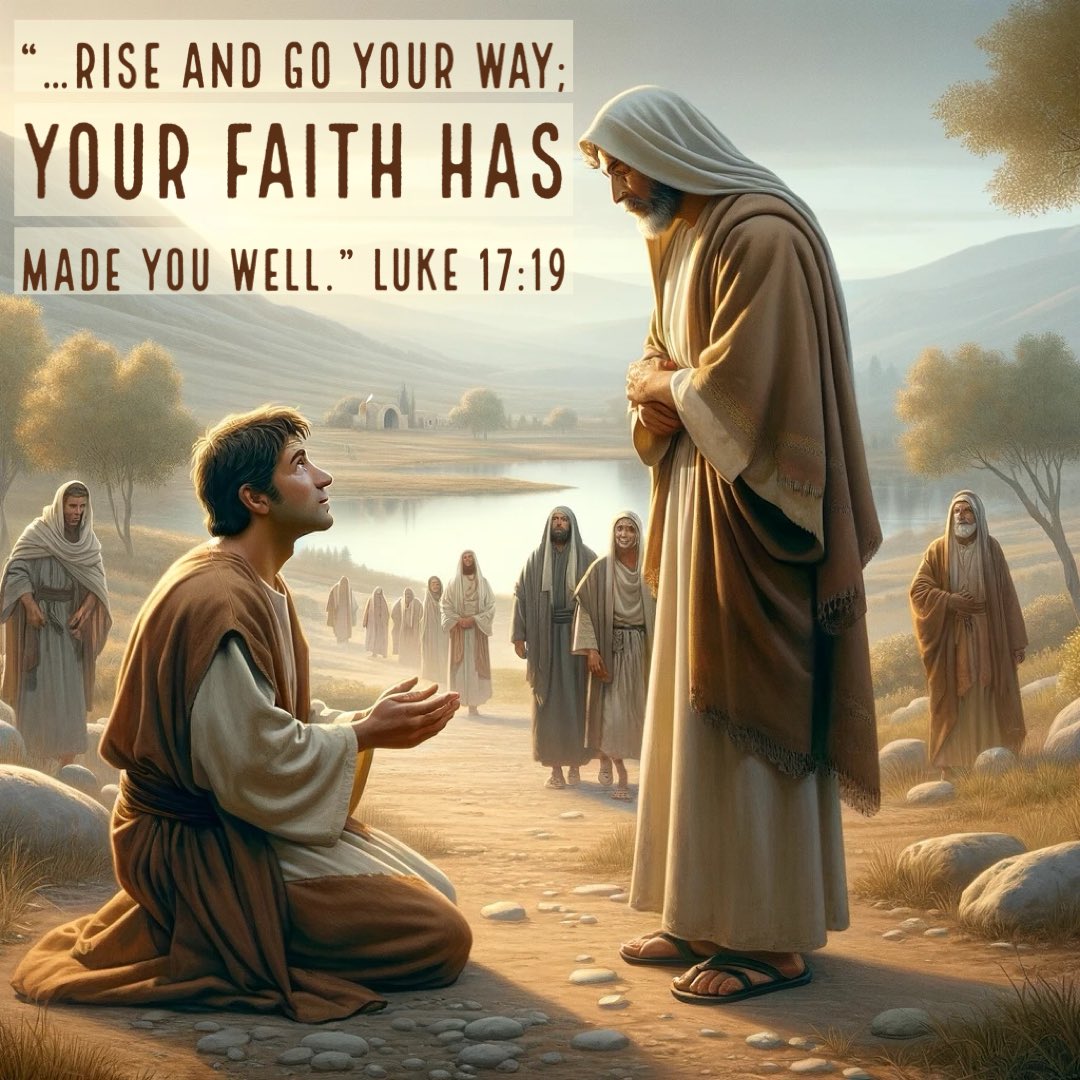
Pocket Share Jesus on X: "“…Rise and go your way; your faith has made you  well.”” Luke 17:19 ESV https://t.co/bIWfdSDOx1 https://t.co/gjWMjLlZml  #BibleVerse #dw4jc #YouVersion #PrayAsYouGo https://t.co/0OKGjWG0kK" / X

Lastly, although they received physical wholeness (by becoming clean from leprosy), the nine ex-lepers missed out on the blessings of spiritual wholeness because of their ingratitude–– for it is only that one thankful ex-leper who Jesus told: arise, go your way, your faith has made you whole”.

WAITING

We live in a world where the word “wait” or “waiting” carries a lot of negative connotations. The culture is so fast-paced that we consider delays to be (almost) a crime. We view delay as an enemy to our progress…..but, sometimes, God loves to communicate using a register of waiting. God promised Abraham a son when he was seventy-five years old. But God fulfilled His promise after twenty-five years. Abraham was a hundred years old when he had Isaac. The point here is that we cannot rush God. His ways are not our ways. There is a popular saying that God has three replies: Yes, No, and Wait!  

So, how do we deal with times when God tells us to wait?

Abraham throughout the twenty-five years of waiting, after God had promised him a son, kept God’s promise in his heart. Although there were times he doubted, one thing was sure: He never let go of God’s promise.

“And God said Unto Abraham, As for Sarai thy wife, thou shall not call her name Sarai, but Sarah shall her name be. And I will bless her, and give thee a son also of her: yea, I will bless her, and she shall be a mother of nations; kings of people shall be of her. Then Abraham fell upon his face, and laughed, and said in his heart, shall a child be born into him that is a hundred years old? and shall Sarah, that is ninety years old, bear?” (Genesis 17:15-17).

 We can see in these Bible above verses the moments of Abraham’s doubts but, lo, it was at that age God answered him. Are you expecting an answer concerning a situation from God? Are you waiting for God’s approval concerning a decision you want to make? While you wait, keep holding on to God’s promises for you. Sometimes, God allows us to wait in order to teach us lessons that will eventually mould us into what He wants us to be. It could be lessons about patience, kindness, or deep love for Him. God also uses our waiting period to build and sharpen our character. So while He asks us to wait, it is not because He does not want to give us what we asked for but because He wants us to build our capacity to be able to carry or manage it.

Also, Ecclesiastes 3:1 says, “To every thing there is a season, and a time to every purpose under heaven.” Therefore, God might tell us to wait because the time of the manifestation of that which we are asking for is not yet right. We just need to align ourselves to God’s desire. God is not incapable of doing what we ask of Him. God told Abraham in Genesis 18:10, ” I will certainly return unto thee according to the time of life; and lo, Sarah thy wife shall have a son. And Sarah heard it in the tent door, which was behind him.” In the 14th verse of the same chapter verse 14 says, we are told: “Is there any thing too hard for the Lord? At the time appointed I will return unto thee according to the time of life, and Sarah shall have a son.”  This verse shows that God has specific times and seasons for the manifestation of our requests. We do not always have the answers to life’s questions and, sometimes, we do not know what decisions to make and actions to take. While you approach God concerning a situation and He tells you to wait, constantly remind Him of all His promises for you and do not allow doubt in your heart. Do not also doubt God’s love for you. ” Like as a father pitieth His children, so the Lord pitieth them that fear him” (Psalm 103:13). Do not keep moving when God tells you to wait because others are moving. Every man’s walk with God is peculiar. Overall, waiting can be the most difficult thing to do but it would be worth it in the end. May God

Also, Ecclesiastes 3:1 says, “To every thing there is a season, and a time to every purpose under heaven.” Therefore, God might tell us to wait because the time of the manifestation of that which we are asking for is not yet right. We just need to align ourselves to God’s desire. God is not incapable of doing what we ask of Him. God told Abraham in Genesis 18:10, ” I will certainly return unto thee according to the time of life; and lo, Sarah thy wife shall have a son. And Sarah heard it in the tent door, which was behind him.” In the 14th verse of the same chapter verse 14 says, we are told: “Is there any thing too hard for the Lord? At the time appointed I will return unto thee according to the time of life, and Sarah shall have a son.”  This verse shows that God has specific times and seasons for the manifestation of our requests. We do not always have the answers to life’s questions and, sometimes, we do not know what decisions to make and actions to take. While you approach God concerning a situation and He tells you to wait, constantly remind Him of all His promises for you and do not allow doubt in your heart. Do not also doubt God’s love for you. ” Like as a father pitieth His children, so the Lord pitieth them that fear him” (Psalm 103:13). Do not keep moving when God tells you to wait because others are moving. Every man’s walk with God is peculiar. Overall, waiting can be the most difficult thing to do but it would be worth it in the end. May God

Also, Ecclesiastes 3:1 says, “To every thing there is a season, and a time to every purpose under heaven.” Therefore, God might tell us to wait because the time of the manifestation of that which we are asking for is not yet right. We just need to align ourselves to God’s desire. God is not incapable of doing what we ask of Him. God told Abraham in Genesis 18:10, ” I will certainly return unto thee according to the time of life; and lo, Sarah thy wife shall have a son. And Sarah heard it in the tent door, which was behind him.” In the 14th verse of the same chapter verse 14 says, we are told: “Is there any thing too hard for the Lord? At the time appointed I will return unto thee according to the time of life, and Sarah shall have a son.”  This verse shows that God has specific times and seasons for the manifestation of our requests. We do not always have the answers to life’s questions and, sometimes, we do not know what decisions to make and actions to take. While you approach God concerning a situation and He tells you to wait, constantly remind Him of all His promises for you and do not allow doubt in your heart. Do not also doubt God’s love for you. ” Like as a father pitieth His children, so the Lord pitieth them that fear him” (Psalm 103:13). Do not keep moving when God tells you to wait because others are moving. Every man’s walk with God is peculiar. Overall, waiting can be the most difficult thing to do but it would be worth it in the end. May God

Also, Ecclesiastes 3:1 says, “To every thing there is a season, and a time to every purpose under heaven.” Therefore, God might tell us to wait because the time of the manifestation of that which we are asking for is not yet right. We just need to align ourselves to God’s desire. God is not incapable of doing what we ask of Him. God told Abraham in Genesis 18:10, ” I will certainly return unto thee according to the time of life; and lo, Sarah thy wife shall have a son. And Sarah heard it in the tent door, which was behind him.” In the 14th verse of the same chapter verse 14 says, we are told: “Is there any thing too hard for the Lord? At the time appointed I will return unto thee according to the time of life, and Sarah shall have a son.”  This verse shows that God has specific times and seasons for the manifestation of our requests. We do not always have the answers to life’s questions and, sometimes, we do not know what decisions to make and actions to take. While you approach God concerning a situation and He tells you to wait, constantly remind Him of all His promises for you and do not allow doubt in your heart. Do not also doubt God’s love for you. ” Like as a father pitieth His children, so the Lord pitieth them that fear him” (Psalm 103:13). Do not keep moving when God tells you to wait because others are moving. Every man’s walk with God is peculiar. Overall, waiting can be the most difficult thing to do but it would be worth it in the end. May God

Also, Ecclesiastes 3:1 says, “To every thing there is a season, and a time to every purpose under heaven.” Therefore, God might tell us to wait because the time of the manifestation of that which we are asking for is not yet right. We just need to align ourselves to God’s desire. God is not incapable of doing what we ask of Him. God told Abraham in Genesis 18:10, ” I will certainly return unto thee according to the time of life; and lo, Sarah thy wife shall have a son. And Sarah heard it in the tent door, which was behind him.” In the 14th verse of the same chapter verse 14 says, we are told: “Is there any thing too hard for the Lord? At the time appointed I will return unto thee according to the time of life, and Sarah shall have a son.”  This verse shows that God has specific times and seasons for the manifestation of our requests. We do not always have the answers to life’s questions and, sometimes, we do not know what decisions to make and actions to take. While you approach God concerning a situation and He tells you to wait, constantly remind Him of all His promises for you and do not allow doubt in your heart. Do not also doubt God’s love for you. ” Like as a father pitieth His children, so the Lord pitieth them that fear him” (Psalm 103:13). Do not keep moving when God tells you to wait because others are moving. Every man’s walk with God is peculiar. Overall, waiting can be the most difficult thing to do but it would be worth it in the end. May God give us grace to wait even in the hardest of times.

Author: Temilade Oluwanifemi

WISDOM

Wisdom is a word that is often used but not always fully understood. In the Bible, wisdom is described as the ability to make good decisions, understand the world around us, and live in a way that pleases God. In Proverbs, we read that “the fear of the Lord is the beginning of wisdom” (Proverbs 9:10). This means that wisdom begins with proper respect and reverence for God.

One of the key characteristics of wisdom is that it is practical. It is not just a collection of knowledge or information, but rather a way of living that is rooted in God’s word. The book of James tells us that “if any of you lacks wisdom, let him ask God, who gives generously to all without reproach, and it will be given him” (James 1:5). This means that wisdom is not something that we can acquire on our own, but rather something that God gives to us when we ask for it.

Another important aspect of wisdom is that it is not just for the elite or the highly educated. In the Bible, we see that wisdom is not just for the elite or the highly educated, but for everyone. In the book of Proverbs, for example, we read that “the fear of the Lord is the beginning of wisdom, and the knowledge of the Holy One is insight” (Proverbs 9:10). This means that wisdom is not just for the elite or the highly educated, but for everyone.

In addition, wisdom is not just for the young, but also for the old. In the book of Job, we read that “Wisdom is with the aged, and understanding in length of days” (Job 12:12). This means that wisdom is not just for the young, but also for the old. As we grow older, we have more experiences and more opportunities to learn from our mistakes, which can help us to become wiser.

Furthermore, wisdom is not just for men but for women too. Throughout the Bible, we see many examples of wise women, such as Deborah in the book of Judges, who was a judge and a prophetess, and Abigail in the book of 1 Samuel, who was able to prevent a violent confrontation between her husband and King David. These examples show that wisdom is not just for men, but for women too.

Wisdom is also closely related to humility. In the book of James, we read that “God opposes the proud, but shows favor to the humble” (James 4:6). This means that wisdom is closely related to humility. Those who are truly wise are humble, they know that they do not know everything and they are willing to listen to others and learn from them.

In conclusion, wisdom is a vital characteristic that is necessary for a fulfilling and successful life. It is practical, not just for the elite or the highly educated, but for everyone, not just for the young, but also for the old, not just for men but for women too, and it is closely related to humility. We can acquire wisdom by fearing the Lord and asking for it, and by listening to others and learning from them. As we continue to seek wisdom, we will be able to make good decisions, understand the world around us, and live in a way that pleases God.

Shalom,

Albert Smith

Giving.

Ever had to leave work at 5 AM, board a commercial bike, enter a Danfo, jump off it while in motion, get stuck in traffic, get beaten by rain and suffer other mishaps, just to keep a job? Not only that- but to endure that for a couple of years?

Well, this (and in many cases, worse) is what the average employee in Lagos and other urban parts of the world goes through every day. There’s the constant demand to wear a person out, in a bid to earn a living, meet needs and provide for those dear.  Yet, as notable as these luxuries are, one of the most important reasons for money, if not the most I daresay, is to give.

Let the thief steal no more, but rather let him be industrious, making an honest living with his own hands, so that he may be able to give to those in need.

-Ephesians 4:28

All through the scriptures, men were weighed not by how much cattle they owned. Instead, the wealth of a man was discerned by how much he had given away and what such gifts cost him. Yet, as the burden of living keeps getting heavier and the needs keep piling to the roof, there’s hardly anything sufficient left to live on, how much more to give up!

How canI give my hard-earned money (time, emotions, energy, service) away, when what I have isn’t enough?!

This beloved, is the issue with Giving.

The concept of Giving has morphed into an unrecognizable notion, peddled by manipulators and selfishly-ambitious men. Looking into the Scriptures, you’d notice however that Giving is meant to be a satisfying experience – not one that leaves your emotions mangled and strained. Kindly note I didn’t say pleasant, I said satisfying. Giving God’s way is the best way- everyone wins in the end.

So you may ask, why should I give? Why do I have to give? If I work hard to make a living, why do I have to give it all up to a God who is purportedly rich or a person who doesn’t work as hard as I do?

A great place to start is this- Giving is the basis for human relationships. Are you a man or a woman? Do you check that box? Then that’s enough reason to give. Imagine if all the basic services in the world were hoarded and kept for only a select few; so you couldn’t buy a washing machine simply because the inventor decided to make only a few for his family member & friends or you can’t buy fuel to drive because the owners of fueling stations refuse to sell to anyone except their staff. Do you see how exceedingly difficult life would be?

For a brief moment, close your eyes and imagine if Jesus, the greatest gift of all, wasn’t given to the world by Our Heavenly Father. We have eternal life and other perks, simply because God gave his Son and His Son gave up His life for you and me. Glory to God! Giving is an expression of Love, Honour and Thanksgiving. We give not to earn love, we give because we love. Whenever we have cause to give to God or others, we must first put in mind the motive and heart behind that gift. If it’s anything other than these, sadly the giving doesn’t count.

And in the course of time, Cain brought to the Lord an offering of the fruit of the ground.

And Abel brought of the firstborn of his flock and of the fat portions. And the Lord had respect and regard for Abel and for his offering;

But for Cain and his offering He had no respect or regard. So Cain was exceedingly angry and indignant, and he looked sad and depressed.

-Genesis 4:3-5

The world’s first siblings, Cain and Abel had the chance to bring offerings before the Lord. God blatantly ignores the gift of one brother. Of course, he would be pissed. Scriptures highlight something very important, which is how the Lord regarded the individual before his offering. It didn’t matter if Cain brought a truckload of fresh vegetables from his farm, he had a heart issue that needed settling and his Giving couldn’t rectify this.

[And the Lord said to Cain, Why are you angry? And why do you look sad and depressed and dejected?

If you do well, will you not be accepted? And if you do not do well, sin crouches at your door; its desire is for you, but you must master it.

-Genesis 4:6-7

God ignored the act of giving and pointed out what’s more important – Cain’s heart posture. The prescription for a rejected offering wasn’t to give more; that wouldn’t eradicate the underlying problem.

We all know how that story ends.

The point is before Giving can be Giving, it has to be done from a place of relationship; a place of love. Giving to God or a fellow man without this basic requisite is nothing short of manipulative. This is the only way to give without any strings attached and to enjoy the process, while at it.

Whoever finds [hoards] his life will lose it and whoever loses [gives] his life on My account will find it.

-Matthew 10:39

Remember, there’s nothing received that wasn’t given by the Lord. Be it your time, money, resources, skill, talent- whatever it may be, give it up.

You’d find more waiting in store for you; more than you ever gave.

-From your sister with the same Abba,

Praise Samuel. 

Receiving the Word

RECEIVING THE WORD

The word of God is not a scam, but when we don’t know how to properly use the word of God, it looks as if it is powerless.

Sometimes people think the word of God is powerless in their lives but the word of God is like a messenger

Psalms 107.

The word of God can be sent.

Just like the way I can send someone to you, you have the choice to either receive the person or reject the person. Just like our lord Jesus Christ telling his disciples: “whoever receives you, then you should enter his house but whosoever shall not receive you, take your sandals, dust it and move”. So the choice belongs to a man to either accept you or reject you. So it’s either they receive the word of God or they reject it.

Sometimes people reject the word of God but they do not know that they’re rejecting the word of God. Sometimes we have been missing it, but studying the word helps us.

There are two sides to the word of God. The written and the spoken (sent word). The written word is referred to as the Scripture (Logos), 2 Timothy 3:16. On the other hand, Spoken words are the word that is revealed (Specific).

The word of God has many functions (expression): 2 Timothy 3:16

It gives you understanding and exposition.

The word of God reproves us

The word of God disciples us and corrects us

The word of God gives us instructions. Instructions are not advice. Just like “Rejoice evermore”. It is not a suggestion but an instruction.

There are different attitudes to which we must receive the word without which the word will not work.

Thanksgiving

Meekness

Faith

Patience

Joy

Determination

They are crucial in receiving the word, or else you won’t have the best in the word of God.

THANKSGIVING

Philippians 4:6-7. It is with Thanksgiving that we get peace. As much as we want to receive peace before thanking God, we have to understand that it is our Thanksgiving that produces peace.

Why are we meant to thank God? Isaiah 55:11

The fact that God always hears us is a good reason to thank him.

MEEKNESS (humility, Simplicity of the heart)

James 1:21.

For God’s word to help you, you must be simple. Matthew 15:21-28.

God is not an unrighteous judge. In the above scripture, Jesus wanted to test the woman, he wanted to know her heart. Imagine if she was offended and left, something might happen to her daughter but she received God’s word with meekness.

FAITH

You must believe God, his word, and his servant. To have faith you must first believe that God is God.

Heb 4:2, how are you saved? You must hear the word, you must believe it.

Roman 10:10; faith here talks about believing in the word of God.

Matt 14:25-29. From Peter’s statement “if it is thou, bid me come unto thee on the water”. He was able to walk on water because of faith, he knew that all he needed from Jesus was just the word “come”, and he had faith and he walked on water. The word of God became the vehicle through which he walked on water.

You must believe the word of God, it is your believing that qualifies you to see the experience of it. It is faith that sponsors our practicing God’s word.

PATIENCE

Patience is a character of maintaining rest even in the phase of contrary symptoms in the journey of the word of God.

ROM 15:4, our finding hope is based on patience and comfort in God’s word.

Heb 10:36. What is the will of God? Confession of faith. You still need patience even after confessing God’s word.

The word of God works gradually, like a drug that when taken in, takes time for someone to recover. Recovery is a process; you need patience after speaking the promise.

James 1:4. Patience must have her work in you.

Luke 8:11-15.

JOY

Isa 12:3 ” with joy we draw from the treasures of God’s word”. We must receive God’s word with joy.

Joy is related to Thanksgiving. You can’t thank God when you don’t have joy.

When we study the gospel, we see what happened to Christ but when we study the epistle we see what happens in him. we can’t do that when we lack joy.

Matt 13:20-21. Receiving the word with joy is a crucial aspect of receiving God’s word. No man gets the best of God’s word by being doubtful. We get the best of God’s word by rejoicing in him.

Sometimes at the place of rejoicing, faith is obtained.

DETERMINATION.

Matt 13:20-21. You must receive God’s word with determination.

Determination for what?

Determination to wait for his word to come to pass. There’s a certain degree of stubbornness to see God’s word come to pass. There’s a level of violent faith. You must be determined to keep pushing through despite odd circumstances.

Conclusion;

Hearing the word of God produces faith. ROM 10:19, but you must design your heart to utilize the faith. when you hear the word faith is supplied to your spirit, you must be determined not to waste that faith. you must be determined to practice your faith, act on it and let his will be done.

Author: Blessing Ifeoluwa